


If you're running a successful UK limited company, building cash inside it, and wondering whether a holding company is the next smart move, you're asking the right question. Most directors reach this point after a few good years. Profits are piling up, risk feels more real, and the idea of leaving everything inside one trading company starts to look careless.
That instinct is usually sound. A holding company can protect assets, create flexibility, and make future planning cleaner. It can also add cost, admin, and tax risk if it's built for the wrong reason or structured badly.
The issue isn't just how to set up holding company paperwork. It's whether the structure improves your position once tax, compliance, extraction plans, IR35 exposure, and asset protection are all taken into account.
Is a Holding Company Right for Your Business
A contractor has a good year, leaves a healthy cash balance in the company, then starts wondering whether that money should stay in the same business that signs client contracts and carries IR35 risk. That is usually the point where a holding company becomes a serious strategic question, not just a Companies House exercise.
A holding company is a parent company that owns shares in another company, usually your trading company. The structure is simple on paper. The decision is not.
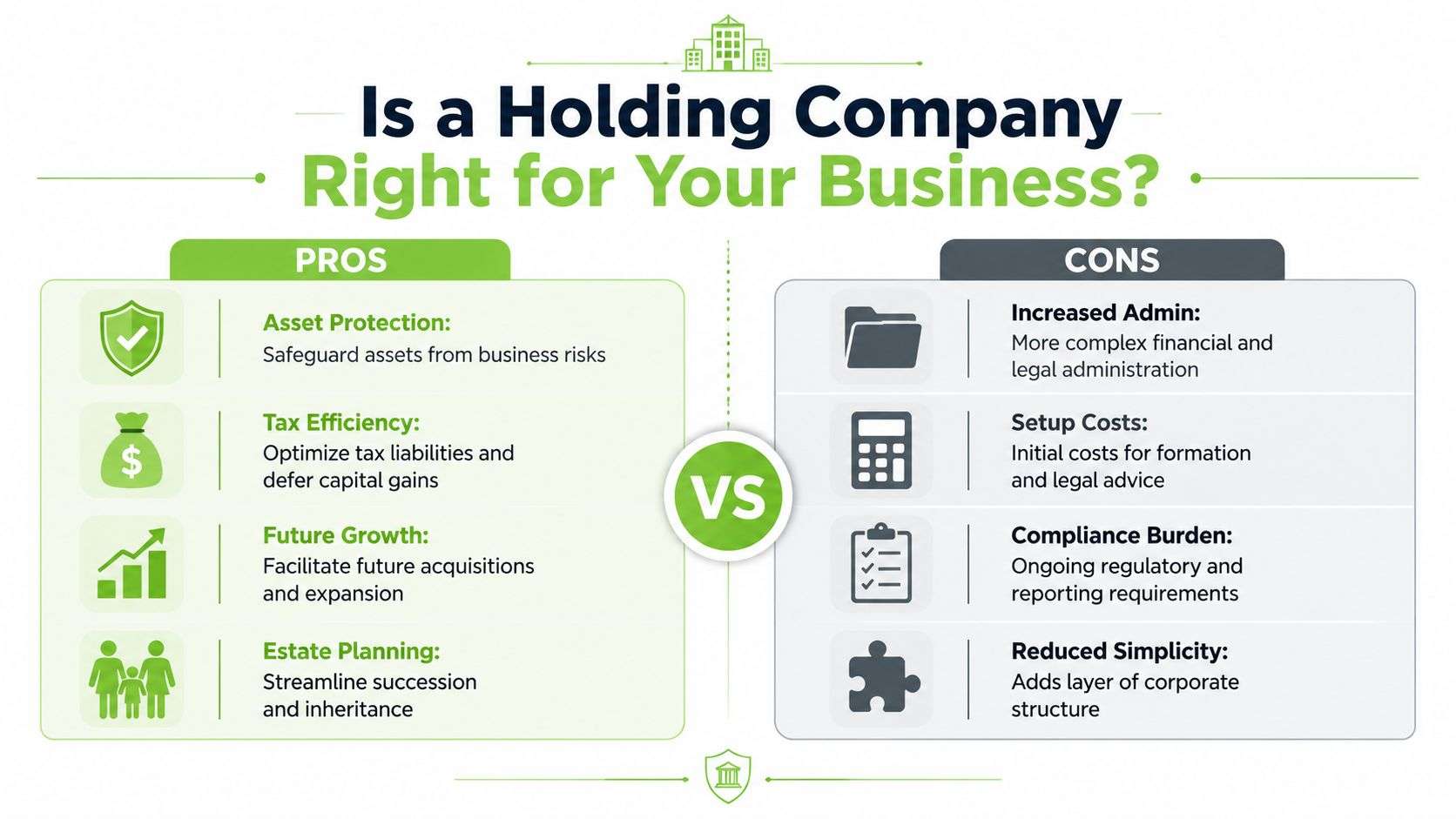
When the structure earns its keep
For UK contractors, a holding company tends to make sense once profits are being retained for a reason. That might be investment, a future property purchase through a separate vehicle, acquiring another business, or getting surplus cash away from the company exposed to trading disputes and status risk.
The commercial case usually starts with asset protection. If the trading company is the entity billing clients, dealing with agencies, and carrying the practical exposure around contract disputes or an HMRC enquiry, keeping all surplus cash and valuable assets in that same company is rarely ideal. A parent company can help separate accumulated wealth from day-to-day trading risk.
It can also improve flexibility inside the group. Where the conditions are met, dividends can often move from the trading company to the holding company without an immediate personal tax charge. That matters if the plan is to reinvest at group level rather than extract funds for personal spending. The saving is about deferral and control, not avoiding tax altogether.
Sale planning is another reason. A cleaner split between the trading company and non-trading assets can make due diligence easier and reduce the chance that a buyer is forced to pick through excess cash, investments, or intellectual property that should have been separated earlier.
There is also a practical point many advisers skip. A holding company can reduce concentration risk, but only if it is set up before the pressure arrives. Trying to move cash, shares, or assets after a dispute starts, or after an IR35 problem is already in view, is far less effective and can create its own tax issues.
When it is probably overkill
Many UK contractors set one up too early.
If you draw most of the profit each year, have no meaningful assets to ring-fence, and are unlikely to buy another business or build a group, the extra company may do little more than increase admin. You still have another set of accounts, another confirmation statement, another bank account to run properly, and another layer of bookkeeping and tax advice.
That cost is not just financial. Group structures create more room for mistakes. Share transfers need to be handled correctly. Intercompany dividends need proper paperwork. Asset transfers can trigger tax consequences if they are done casually. If your current company setup is still basic, start by making sure the trading company is structured properly. For many directors, that means fixing the fundamentals of their limited company setup for contractors before adding a parent company on top.
A holding company is also not a cure for IR35. If your underlying contracts, working practices, and client relationships point to caught engagements, adding a parent company does not change that analysis. In some cases, contractors get distracted by structure and miss the larger risk sitting in the trading business.
The decision test that matters
A holding company is usually worth proper analysis if several of these apply at the same time:
- You expect to retain profits in the business rather than extract most of them personally
- You want surplus cash, investments, or intellectual property outside the main trading company
- You may launch a second trading activity or buy another company
- You want cleaner sale planning in the future
- You are prepared for the extra compliance and the professional fees that come with doing it correctly
If only one of those points fits, caution is sensible. If several fit, the structure may be useful.
The main judgment is whether the company is accumulating business wealth that needs protecting and deploying, or producing income that you plan to draw out. That distinction drives almost every tax and structuring decision that follows.
The Legal Steps to Form a UK Holding Company
A contractor with one profitable company often assumes the holding company is the easy bit. The Companies House filing usually is. The risk sits in what gets set up around it. If the parent is formed casually, you can create admin noise, muddy ownership, and make later tax planning harder than it needs to be.

Form the parent company with the group in mind
The first legal step is to incorporate a new UK limited company at Companies House. If you already know the basics of limited company set-up for contractors, the filing process will look familiar. The difference is purpose. This company is being created to own shares in another company and control a group, not to win contracts and trade in its own name.
That changes a few decisions from day one. The company name should still make sense if you add a second trade later. The registered office, officer appointments, and share structure should also be chosen on the basis that this company may sit at the top of several businesses or hold valuable assets.
SIC code selection matters, but it is often overstated. A pure holding company will usually use 64209 for activities of other holding companies not elsewhere classified. Filing the wrong SIC code does not by itself create an HMRC penalty. What matters more is that the company's real activity, records, and tax treatment match what it does.
The larger point is operational discipline. If the parent starts invoicing clients, employing staff for trading work, or paying mixed personal and business costs, you lose the clean separation that makes a group useful in the first place.
Get the constitutional documents right
Template documents are legally acceptable. They are often a poor fit for a group.
For many single-director contractors, standard model articles are enough to get incorporated. They are not always enough to support what comes next. If the parent will control a subsidiary, admit a spouse or investor later, issue different share classes, or ring-fence decision-making around asset ownership, the articles need to reflect that.
I see problems here most often when directors rush the incorporation, then try to retrofit proper governance after value has built up in the trading company. That is usually more expensive and can create awkward shareholder consents, tax advice costs, and document corrections that were avoidable at the start.
If more than one shareholder is involved, a shareholders' agreement may also be sensible. It will not replace the articles, but it can deal with deadlock, exits, dividend expectations, and who controls major decisions across the group.
A valid incorporation is not the same as a structure that is fit for future funding, extraction planning, or a sale.
Put separate operations in place from day one
The parent needs its own bank account, accounting records, confirmation statement, and corporation tax compliance. It may look inactive compared with the trading company, but it is still a separate legal person.
That means no blended money and no lazy bookkeeping.
Use a practical checklist:
- Choose a name that works above the trading company. Avoid naming it so narrowly that it becomes awkward if you add another business.
- Select the SIC code that matches the parent's actual role. For a holding company, that is usually about ownership, not trading.
- Appoint directors with control in mind. If spouses, co-founders, or investors are involved, be clear who can authorise what.
- Open a dedicated bank account. Intercompany transfers should be identifiable and supported, not mixed with trading receipts.
- Keep separate bookkeeping from the start. Xero, QuickBooks, and FreeAgent can all work if each company has its own ledger.
- Register and file on the right timetable. Each company in the group has its own filing dates and records, even if one does very little.
- Document intercompany decisions properly. Loans, dividends, and management charges need board minutes and accounting treatment that match reality.
This legal stage is where good habits start. If you want the holding company to protect retained profits, hold investments, or receive dividends from the trading company, clean administration is part of the tax strategy, not an afterthought.
A short overview can help if you want to see the process visually before acting.
Structuring Shares to Create the Group
For most contractors, this is the point where a simple incorporation turns into a real tax planning exercise. The group only exists in a meaningful sense once the new parent owns the shares in the trading company. Until then, you have two companies on paper, not a functioning structure.
In a typical setup, you hold the trading company shares personally. To create the group, those shares are transferred to the holding company, and the holding company issues shares back to you. You stop owning the trading company directly and own the parent instead.

What the share exchange is doing
The usual route is a share-for-share exchange. Done properly, the ownership chain becomes:
- You own the holding company
- The holding company owns the trading company
- The trading company becomes a subsidiary
That sounds straightforward. The risk sits in how the exchange is documented, valued, and treated for tax.
For contractors, the strategic point is easy to miss. If the group is being created to protect retained profits, separate investment assets, or prepare for a future sale, the share structure has to support that objective from day one. A rushed exchange can leave you with avoidable capital gains issues, stamp duty questions, or a structure that causes problems when you later try to extract value or sell part of the business.
Why this part often goes wrong
Directors often assume the legal paperwork is the main task. It isn't. However, the primary work involves checking whether the proposed exchange qualifies for the right tax treatment and whether there is any anti-avoidance risk in the background.
That matters even more if the trading company has built up value, owns intellectual property, or has a history that could attract HMRC attention under IR35 reviews or other status enquiries. The holding company does not erase those risks. It changes who owns the shares.
If you want a broader grounding in capital gains tax on company shares, get that clear before you sign anything. The legal steps and the tax analysis need to point in the same direction.
What good execution looks like
A properly handled share restructuring usually includes:
- A reason for the restructure that can be defended commercially, not just "tax planning" written after the event
- A sensible valuation approach, even where no cash changes hands
- Board minutes and shareholder resolutions that reflect what is happening
- Share transfer forms and new share issue documents prepared in the right order
- A review of tax reliefs and anti-avoidance rules, including whether clearance should be considered
- Updated statutory registers and confirmation statement records so the legal ownership matches the tax position
One more point deserves attention. If other shareholders are involved, including a spouse, co-founder, or outside investor, the exchange can affect control, voting rights, dividend rights, and future exit proceeds. I have seen restructures that looked tidy on the chart but created disputes later because the new holding company shares were issued without properly agreeing who should own what.
This is also the stage where contractors need to be realistic about whether a holding company is justified at all. If the company is small, profits are extracted each year, and there is no plan to ringfence cash or build a wider group, the extra complexity may not earn its keep. If the business is retaining profit, buying assets, or preparing for growth beyond one personal service company, the structure can work well, but only if the share exchange is done properly.
Template documents are not enough here. An accountant who only files returns is rarely the right adviser for this step. You need someone who can check company law, tax reliefs, ownership economics, and HMRC risk together before the restructure goes live.
Managing Group Assets and Tax Efficiently
A contractor builds up strong profits over a few years, leaves the cash in the trading company, signs a risky client contract, then faces a dispute. At that point, the structure chart matters a lot. If valuable cash, investments, or IP still sit in the trading company, they are exposed to the same commercial risk as the trade.
That is why group structures can work well for contractors. Its main advantage is not the extra company on the chart. It is the ability to separate trading risk from accumulated value, while keeping funds inside the corporate group rather than triggering personal tax too early.
Moving surplus profit to the parent
In many UK groups, the trading company can pay dividends up to the holding company out of post-tax profits. Done properly, that gives you options. Funds can be retained for future investment, used to capitalise another subsidiary, or held away from the company that signs contracts and carries day-to-day liability.
The tax point is straightforward. Personal extraction is usually the expensive stage. If you do not need all profits for living costs, pulling everything out as salary or personal dividends often creates an unnecessary tax charge now instead of later.
For a clear explanation of how company dividends are taxed in the UK, it helps to separate dividends paid to you personally from dividends moving between group companies.
That said, a holding company does not create magic. If profits still end up funding school fees, mortgages, and personal spending, the tax bill is only deferred, not avoided.
Asset separation needs planning, not optimism
Contractors often form a holding company because they want to protect cash or ringfence intellectual property. The instinct is sensible. The execution is where mistakes happen.
Cash is usually the simpler case. If the trading company has distributable reserves, profits may be paid up to the parent and held there, subject to the legal and accounting position.
IP, property, and other business assets need more care. A transfer can trigger tax, stamp taxes, VAT issues, accounting consequences, or questions about market value. If the asset is important to the trade, you also need the legal paperwork to let the trading company keep using it, often through a licence or formal intercompany agreement.
I have seen contractors move assets after the fact, once value has already built up, and then discover the transfer is far more expensive and harder to defend than expected. Early planning usually gives you better options.
Where the structure earns its keep
A simple comparison shows the commercial difference:
| Metric | Standard Limited Company | Holding Company Structure |
|---|---|---|
| Annual profit before extraction | £150k | £150k |
| Immediate approach | Director takes most surplus personally | Trading company can pass part of surplus to parent for reinvestment |
| Personal tax pressure | Higher, because extraction happens now | Lower immediate personal pressure if funds stay in the group |
| Asset protection | Cash often remains in the trading company until extracted | Surplus can be moved away from frontline trading risk |
| Investment flexibility | Often depends on taking money out first | Group can retain funds for future use |
| Sale planning | Assets and trading activity may be mixed together | Cleaner separation between trade and stored value |
The tax saving is not always the headline benefit. Control is. A group can let you decide later whether surplus cash should fund investments, support a second venture, or stay protected from trading exposure.
For contractors caught by or close to IR35, that distinction matters even more. If most profits are still being earned from one personal service company and extracted to support personal spending, the group may add cost without changing the economic reality very much. If profits are being retained for wider commercial use, the structure starts to justify itself.
What usually works
- Retaining profits above your personal spending needs
- Separating excess cash from the company taking contractual risk
- Holding investment capital at parent level for future acquisitions or new ventures
- Licensing valuable assets to the trading company under proper agreements
- Creating cleaner sale planning where trade and retained value are not mixed together
What usually goes wrong
- Moving assets with no valuation support
- Assuming intercompany transfers are automatically tax neutral
- Leaving cash in the trading company out of habit
- Using the holding company to pay personal costs
- Building a group when profits are still needed personally each year
A holding company is usually strongest where there is retained profit, identifiable risk, and a real plan for the capital. It is usually weak where the structure exists only because someone said it was “more tax efficient” without asking what the money is intended for.
If you are transferring assets rather than just upstreaming post-tax profits, get tax and legal advice before anything moves. That is the point where small errors become expensive ones.
Common Pitfalls and Ongoing Compliance
A typical pattern looks like this. The holding company is formed correctly, the share structure is tidy, and the first dividend goes up to the parent without drama. Six or twelve months later, the records no longer match the intention. Costs are paid from the wrong entity, intercompany balances are unclear, VAT has been ignored on management charges, and the director assumes the group can be treated as one pot of money.
That is where holding company structures start getting expensive.
Ongoing compliance is heavier than many contractors expect
A group gives you more control, but it also creates more points of failure. Each company needs its own bookkeeping, statutory records, accounts, corporation tax review, and board-level decision trail where relevant. If one company invoices, another pays, and a third owns the asset, the paperwork has to support that reality.
The extra cost is not just Companies House admin. It is accounting time, tax review, and the discipline to keep transactions properly documented throughout the year.
Contractors who already run a tight finance process usually cope well. Contractors who leave everything until year end often find the group makes existing weaknesses harder to contain.
VAT is one of the easiest ways to get caught out
VAT problems often start with something that feels commercially sensible. The parent pays for software used across the group. One company employs staff who support another. A central company recharges overheads or management time. Directors often assume those are internal movements with no real VAT effect. That assumption can be wrong.
Whether VAT applies depends on the legal entity supplying the service, whether a recharge is being made, whether there is a VAT group in place, and whether the treatment has been followed consistently. HMRC's guidance on VAT groups and intercompany supplies is the right starting point, but the practical answer usually depends on the facts of your setup: HMRC VAT groups guidance.
The trap is not only underpaid VAT. It is also poor recovery, incorrect invoicing, and historic errors that have to be corrected after the structure has been running for some time.
Director's loan accounts become more dangerous in a group
One company pays a personal expense. Another clears it later. A third company advances funds because cash is sitting there. That is how messy director's loan positions develop.
Connected companies do not cancel out the tax risk. Each legal entity stands on its own. If money leaves a company for the director without the right treatment, you can trigger tax charges, close company loan issues, benefit questions, and a year-end clean-up exercise that costs far more than the original transaction was worth.
Groups work best when cash movements are deliberate, recorded, and backed by the right legal basis.
A holding company improves strategic flexibility. It also exposes weak finance habits very quickly.
IR35 risk stays with the underlying engagement
A parent company does not change the nature of a contract. If the end client relationship, working practices, and control position point towards employment, adding a holding company above the personal service company does not repair that.
While some contractors build a group expecting broader tax advantages, the underlying commercial risk still sits in the trading company's contract model. If that company is inside IR35 in substance, the group has not solved the core issue. It has only added another layer that needs to be administered properly.
Mistakes that keep recurring
- Posting costs to the wrong company and trying to tidy it up later
- Recharging shared costs without reviewing VAT
- Letting intercompany balances build up without agreements or reconciliation
- Using group companies to cover personal spending
- Missing separate filing obligations because the group is treated as one business
- Assuming the holding company changes IR35 exposure when the contract terms and working practices do not
A holding company can be commercially strong and tax-efficient for the right contractor. It can also fail if the group is not run with discipline after formation. The filing is the easy part. The crucial test is whether the structure still makes sense, and is still being operated correctly, a year later.
When You Must Consult a Specialist
A holding company can be excellent for the right contractor. It can protect assets, improve flexibility, and create a better platform for long-term planning. It can also produce the wrong result if the legal steps are rushed or the tax position is guessed.
The line between sensible DIY understanding and specialist work is quite clear. Once you're changing ownership, moving assets, or relying on reliefs, the risk goes up sharply.
You should get specialist advice if any of these apply:
- You're carrying out the share-for-share exchange
- You're transferring intellectual property, property, or other material assets
- You have a spouse or multiple shareholders involved
- You're planning for a future business sale
- You're concerned about IR35, VAT grouping, or director's loan issues
- You want the structure for tax efficiency, not just legal neatness
The best approach is to understand enough to ask the right questions, then bring in proper advice where mistakes become expensive. That's usually the point where a holding company stops being a filing exercise and becomes a tax strategy.
If you're weighing up whether a holding company will improve your position, Tax Compass helps UK limited company directors and contractors understand the tax trade-offs before they commit. It's a useful place to review related strategies, sense-check whether the structure fits your income pattern, and decide when it's time for specialist advice.