


A lot of directors reach the same point at roughly the same time. The business needs better equipment, newer systems, more capacity, or a proper refit, and the commercial decision is obvious. The tax decision isn't.
That's where the annual investment allowance becomes more than a technical rule in a capital allowances note. Used well, it can improve cash flow, reduce your corporation tax bill sooner, and shape the timing of a purchase. Used casually, it becomes little more than a box ticked after the money has already gone out the door.
The difference matters most when the spending is meaningful. Plenty of businesses know the allowance exists, but that's not the same as planning around it. HMRC's review found that awareness of the AIA was generally good, yet the relief was most beneficial to SMEs whose investment sat around the allowance threshold, which tells you something important. Recognition is common. Optimisation isn't (HMRC's efficacy review of the annual investment allowance).
Maximising Your Capital Expenditure
A director buying new machinery or replacing ageing IT usually starts with the obvious questions. Can the business afford it, will it improve output, and how quickly will it pay back?
The tax angle often comes later, and that's where value gets lost. If you treat capital expenditure as a simple purchase, you claim what's available after the event. If you treat it as a planned tax event, you start asking better questions before signing anything.
Where directors usually leave value behind
The most common mistake isn't failing to claim the annual investment allowance at all. It's failing to ask whether the timing, asset mix, and wider tax position make that claim more valuable now than later.
A director might approve an office fit-out in one accounting period, buy equipment in another, and only discover at year end that a different sequence would've produced a better result. Another might assume all equipment should go through AIA without checking whether another first-year relief would be a better fit for part of the spend.
Practical rule: The annual investment allowance is most useful when it becomes part of the buying decision, not an afterthought in the tax return.
The shift from awareness to strategy
Once you look at AIA properly, the question changes. It's no longer just, “Can this asset qualify?” It becomes:
- When should we incur the spend? A few days can matter in the wrong accounting period.
- Which assets deserve the fastest relief? Not every qualifying purchase needs the same treatment.
- What is the cash flow impact this year? Immediate relief can change the effective after-tax cost of an investment.
For a busy company director, that's the true value of understanding capital allowances. You're not trying to become a tax technician. You're trying to make a better commercial decision with the tax consequences in full view.
What Is the Annual Investment Allowance
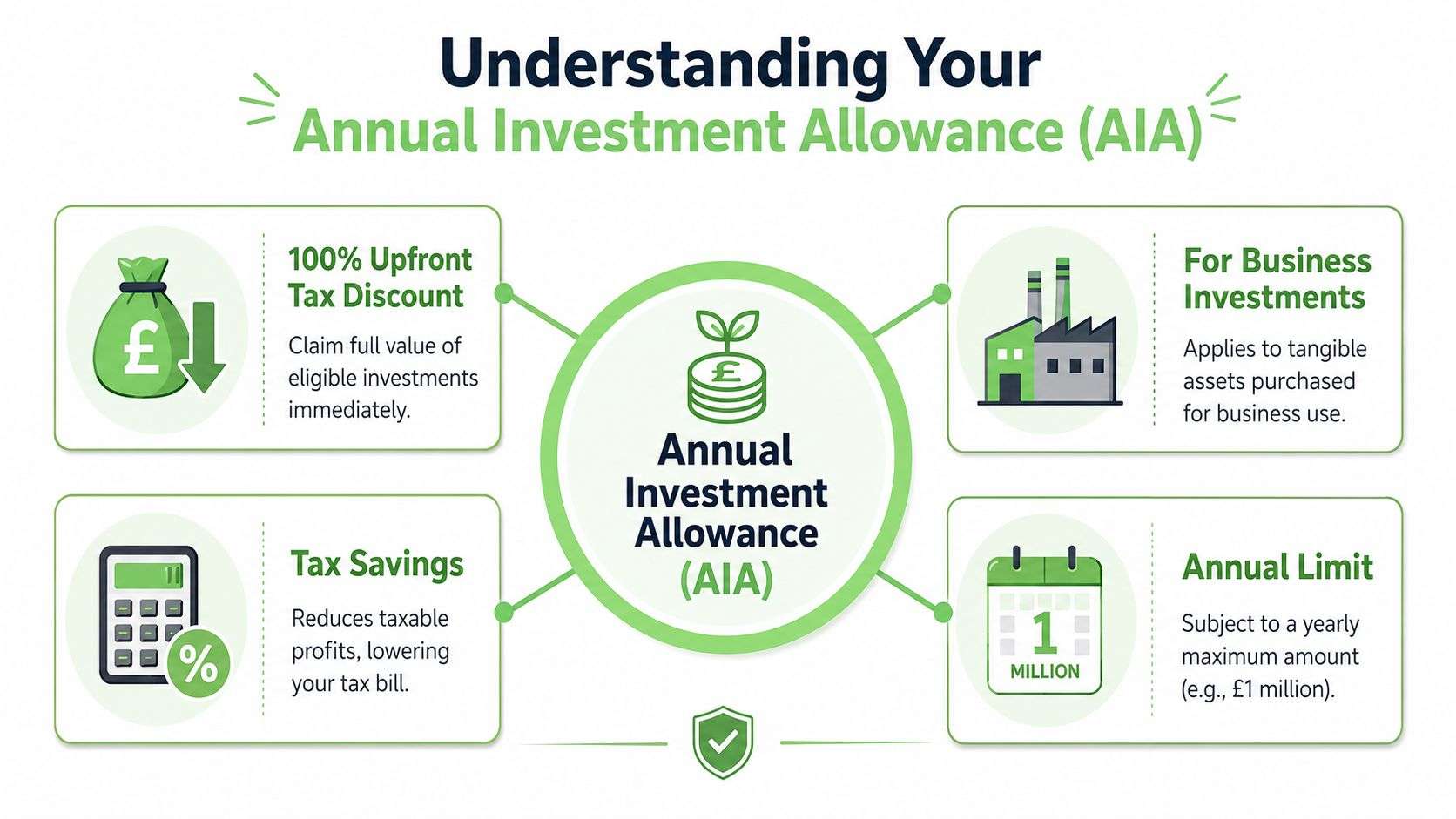
The Annual Investment Allowance, usually shortened to AIA, lets a business claim a 100% first-year deduction on qualifying plant and machinery spending up to £1 million per accounting period. That £1 million limit is permanent from April 2023, and for a company paying the 25% main corporation tax rate, a full AIA claim could reduce the tax bill by up to £250,000 in that year (guide to the UK annual investment allowance).
Think of it as accelerated tax relief. Instead of spreading relief over several years, the business may deduct the full qualifying amount in the year of purchase, subject to the cap and the normal rules.
A simple visual helps.
Why AIA matters in plain English
If your company buys qualifying equipment, that spend doesn't usually work like rent, software subscriptions, or wages. It's capital expenditure, which means the tax system handles it through capital allowances rather than ordinary revenue deductions.
AIA is the generous version of that system. It gives you a way to bring the tax benefit forward.
Here's the practical effect:
- Without AIA: relief is generally slower and arrives over time.
- With AIA: the qualifying spend can reduce taxable profits straight away, up to the available limit.
- For directors: that often means better near-term cash flow, especially in profitable years.
You're still paying for the asset. AIA doesn't make it free. It changes how quickly the tax system recognises the cost.
Why the allowance sticks in planning conversations
The annual investment allowance matters because it's simple enough to act on. If the company is making a qualifying purchase and has taxable profits, the relief can be both immediate and material.
This short video gives a useful overview before you get into the planning detail.
AIA also applies to both companies and unincorporated businesses, although limited company directors usually focus on its corporation tax effect. The key point is that it applies to qualifying capital expenditure, mainly plant and machinery, not normal running costs.
A quick mental model
If you want a simple way to remember it, use this:
| What you spend on | Tax treatment idea |
|---|---|
| Everyday running costs | Usually deducted as normal business expenses |
| Capital assets for business use | Usually claimed through capital allowances |
| Qualifying plant and machinery within AIA | Potentially deducted in full up front |
That's why AIA often sits at the centre of investment planning. It turns a dry compliance rule into a timing tool.
What Qualifies for the Annual Investment Allowance
Many directors make a common mistake. They understand the value of AIA, then assume any business purchase with a decent invoice qualifies automatically. It doesn't.
The short version is that AIA is available for qualifying plant and machinery, but not business cars. If spending goes above the cap, the excess moves into the standard capital allowances system and is relieved through writing-down allowances at 18% or 8% depending on the pool (ACCA technical guide to annual investment allowance rules).

What usually sits inside AIA
“Plant and machinery” sounds narrower than it really is. In practice, it covers a broad range of business assets.
Typical examples often include:
- IT equipment such as computers, monitors, servers, and related hardware
- Office furniture including desks, chairs, storage units, and similar fixtures
- Commercial equipment used in the trade, such as workshop tools or production machinery
- Business vehicles that aren't cars such as vans and other commercial vehicles
- Certain integral features within business premises, depending on the asset and context
For most directors, the simplest working test is this: if the company is buying a tangible asset to use in the business, and it isn't a car, AIA is worth checking.
The exclusions people often miss
The main exclusion that causes confusion is cars.
A director may buy a vehicle for genuine business use and assume it should fall into AIA because it helps generate income. That commercial logic makes sense, but it isn't how the relief is structured. Business cars don't qualify for AIA.
Other purchases also fall outside the basic idea of AIA, particularly where the spend isn't on qualifying plant and machinery at all. That's why “capital spend” and “AIA-qualifying spend” are not the same thing.
A useful discipline is to separate the invoice list into two buckets before year end. “Qualifying plant and machinery” and “everything else”.
What happens above the limit
Once qualifying expenditure goes beyond the available AIA, the tax relief doesn't vanish. It just slows down.
That excess usually enters the ordinary capital allowances system. At that point, relief is given through writing-down allowances, which means deductions are spread over time rather than taken immediately.
A simple way to think about the difference:
| Spend type | Relief pattern |
|---|---|
| Qualifying spend within available AIA | Full deduction up front |
| Qualifying spend above available AIA | Relief over time through writing-down allowances |
| Non-qualifying spend | Different rules apply, depending on the asset |
A practical review before you buy
Before approving a large invoice, check these points:
- Is the item plant and machinery? If not, AIA may not be the right lens at all.
- Is it a car? If it is, don't assume AIA applies.
- Will total qualifying spend stay within the available limit? If not, part of the tax relief may arrive much more slowly.
- Would another capital allowance be more suitable? That matters more now than it used to.
For directors making several purchases across the year, this classification step is where clean planning begins. If you get the asset type wrong, the rest of the tax calculation can look tidy while still being strategically wrong.
The Mechanics of Claiming AIA
Knowing that a relief exists is useful. Knowing how it reaches your tax bill is what turns it into cash flow.
For a company, AIA is claimed through the corporation tax process as part of the capital allowances computation that feeds into the CT600. It reduces taxable profits by substituting tax relief for accounting depreciation, which is why the bookkeeping entry and the tax result are not the same thing.

What the claim is doing
If your accounts show a profit, that accounting profit is only the starting point for corporation tax. The tax computation then adjusts it.
Capital expenditure doesn't usually get deducted in full just because it appears in the accounts. Instead, you claim capital allowances. AIA is one of those allowances, and where it applies it can reduce taxable profits for the period.
That means the practical flow looks like this:
- Buy a qualifying asset
- Record it in the accounts as capital expenditure
- Include it in the capital allowances computation
- Claim AIA where appropriate
- Reduce taxable profits on the company tax return
A broader view of filing dates and tax periods helps when you're planning this around year end, especially if your accounting period doesn't line up neatly with the tax year. This overview of the UK tax year and key deadlines is a useful companion.
A simple worked example
Take a company that buys £75,000 of qualifying equipment in its accounting period. If that spend qualifies for AIA, the company can deduct the full £75,000 from taxable profits in that period.
If the company pays corporation tax at 25%, the tax effect of that deduction is straightforward:
| Item | Amount |
|---|---|
| Qualifying capital spend | £75,000 |
| AIA claimed | £75,000 |
| Corporation tax rate used | 25% |
| Tax reduction | £18,750 |
That doesn't mean the company receives a cheque for £18,750. It means its corporation tax bill is reduced by that amount compared with a position where the same spend did not receive immediate full relief.
Worked example: A qualifying purchase of £75,000 can reduce a 25% corporation tax bill by £18,750 when AIA is available and fully claimed.
Where directors get muddled
Three points usually cause the confusion:
- Depreciation versus tax relief. Your accountant may add back depreciation in the tax computation, then claim capital allowances separately.
- Invoice date versus timing of expenditure. The date that matters for tax planning can be more nuanced than directors expect.
- Assuming the claim is automatic. The computation still needs to classify the spend properly.
The practical lesson is simple. If the business is making a substantial purchase, don't leave the tax treatment to be inferred later from the bookkeeping records alone. Flag the asset early, confirm whether it qualifies, and make sure the claim is reflected in the tax return computation.
AIA Strategy for Company Directors
For many years, the annual investment allowance was the obvious answer to one main question. Can the company get immediate relief on qualifying plant and machinery?
That's no longer the only strategic question. For companies, full expensing has altered the situation. AIA is still highly relevant, but the better question now is which relief should be used for which asset, and when.
AIA and full expensing compared
AIA is capped at £1 million, while full expensing gives companies a separate 100% first-year deduction for qualifying new main-rate plant and machinery, with special-rate assets eligible for a 50% first-year allowance (Travers Smith overview of AIA and full expensing).
That creates a planning choice. If an asset qualifies for full expensing, you may not want to “spend” AIA on it if AIA could be preserved for items that don't qualify for the newer regime.
Here's the high-level comparison.
| Feature | Annual Investment Allowance (AIA) | Full Expensing |
|---|---|---|
| Basic relief | 100% first-year deduction | 100% first-year deduction for qualifying new main-rate plant and machinery |
| Cap | £1 million | Separate regime, not framed here as the AIA cap |
| Asset focus | Qualifying plant and machinery | Qualifying new main-rate plant and machinery |
| Special-rate treatment | Can be relevant if qualifying within AIA | 50% first-year allowance for qualifying special-rate assets |
| Strategic use | Useful where assets don't fit full expensing or where AIA is better deployed elsewhere | Useful for qualifying new assets so AIA can be preserved |
When preserving AIA makes sense
Many standard explainers stop too early. They ask, “Can I claim AIA?” A better planning question is, “Should I use AIA on this item at all?”
That matters when the company is buying a mix of assets. Some may fit full expensing neatly. Others may not. In that situation, preserving AIA for the purchases that need it most can improve the overall tax position.
Examples of where directors need to think carefully include:
- Mixed asset purchases where only part of the spend fits the newer regime
- Refits and upgrades involving both main-rate and special-rate items
- Used or non-qualifying-for-full-expensing assets where AIA may carry more strategic value
The real decision isn't whether AIA is good. It's whether AIA is the best use of your available immediate relief.
A wider tax strategy often involves more than capital allowances alone. If you're also deciding how to extract profits efficiently, this guide to company pension contributions and tax relief is relevant because major capital spend and profit extraction choices often sit in the same planning discussion.
The timing trap directors miss
The second major issue is timing, especially in straddle periods.
This is one of the most overlooked areas in AIA planning. Where an accounting period straddles a change in the AIA limit, the amount of relief available can depend heavily on when in that accounting period the expenditure is incurred. HMRC-linked analysis noted that when the AIA limit changed back to £200,000 from 1 April 2023, a business in a straddling period could see a ceiling for expenditure in just five days as low as £2,740 (analysis of AIA timing and straddle periods).
That point matters because many directors use a rough rule of thumb: “buy before year end.” In a straddling period, that can be too simplistic. The accounting period dates and the exact timing of expenditure can change the available relief in ways that aren't obvious from the headline annual limit.
What to do before approving major spend
For company directors, the strategic checklist is short but important:
- Map the asset categories first so you know which purchases could fit full expensing and which may rely on AIA.
- Check your accounting period dates before assuming year-end acceleration helps.
- Review the order of purchases if the business is making several investments close together.
- Coordinate tax with profit levels because immediate relief is most valuable when there's taxable profit to shelter.
That's the difference between claiming an allowance and using it well.
Optimising Your Capital Allowances
Directors rarely lose value on capital allowances because the rules are impossible. They lose value because the decisions are made in the wrong order.
The strongest approach is to decide three things before the purchase goes through. First, whether the asset qualifies. Second, which relief is best suited to it. Third, whether the timing of the spend supports the outcome you want.
The short-period issue that changes the maths
One of the easiest traps to miss is the short accounting period. If a company's accounting period is shorter than 12 months, the £1 million AIA limit is prorated. A 6-month period would typically allow £500,000 of AIA claims instead (guide to prorated annual investment allowance limits).
That matters in real life when a company changes year end, starts trading part-way through a period, or goes through a restructuring that alters the accounting period. A director may still be thinking in terms of a full annual allowance when the available cap has already narrowed.
Situations that deserve a closer review
Some purchases are straightforward. Others deserve a proper planning pass before the money leaves the bank.
Look more carefully where any of these apply:
- A short or unusual accounting period because the available AIA may not be what you assume
- Large mixed purchases where some assets could fit different first-year reliefs
- A business acquisition or asset acquisition where the classification of expenditure needs extra care
- Group or connected company issues where capital allowance planning may need a wider view
- Periods close to rule changes where timing can alter the outcome
Decision test: If the purchase is large enough that you'd notice a slower tax deduction, it's large enough to review properly before committing.
AIA is generous, but it isn't a substitute for planning. The biggest gains usually come from matching the right relief to the right asset at the right time, then fitting that into the company's broader tax picture. If you're reviewing major expenditure alongside wider corporation tax planning, this guide on how to reduce corporation tax in the UK gives useful context.
If you want a clearer view of how capital allowances fit into your wider limited company tax position, Tax Compass helps you understand the strategy before you make big decisions. It's a practical starting point if you're weighing investment timing, corporation tax exposure, and the best use of available reliefs.